Picture this: you’re strolling through modern Rome, sipping espresso, and suddenly ancient ruins loom beside you. It’s like stepping between worlds. How did Rome, once a small city, grow to rule the known world?
More importantly, what really happened to this empire?
I’m obsessed with this stuff (history) and travel. I believe the best way to understand the past isn’t through dry dates but by seeing it as a living story of real people. This article will break down the massive saga of ancient Rome history.
We’ll journey through its key periods, legendary figures, and innovations. Let’s make sense of it all.
From Myth to Monarchy: Rome’s Origin Story
The tale of Romulus and Remus is the stuff of legends. Born of a god, abandoned, then raised by a she-wolf. It’s a story that gave ancient Rome its sense of destiny and strength (who wouldn’t want that kind of origin story?).
But let’s be real. Rome started as a simple settlement by the Tiber. They picked up a lot from neighbors like the Etruscans.
This ancient Rome history period was like a startup phase, full of experimentation.
Enter the age of the Roman Kingdom, ruled by seven kings. This was when Rome began to shape its institutions. The Senate took root here, a key piece later on.
But, Rome had its own Game of Thrones moment with King Tarquinius Superbus. His tyranny pushed people over the edge. They hated absolute power so much they set up a republic, ensuring checks and balances.
This fear of tyrants defined their politics for centuries. It’s like they set the stage for their own drama series. If you’re into cultural takeaways, maybe exploring rich culture morocco can show more about how these early dynamics still connect.
The Rise of the Republic: Power, People, and Expansion
The Roman Republic was a bit like a modern-day representative democracy but with togas and a lot more marble. Instead of a king, they had elected officials called Consuls and a solid Senate. Sounds familiar, right?
But this wasn’t all smooth sailing. The Republic had its own version of class warfare: the Struggle of the Orders. This was the epic battle between the wealthy Patricians and the common Plebeians.
Think of it as an early fight for civil rights. The Plebeians wanted more say and protection under the law, which led to the creation of the Twelve Tables. The foundation of Roman legal code.
Now, let’s talk about the Punic Wars. These were not your average neighborhood disputes. We’re talking Hannibal crossing the Alps with elephants.
Can you imagine? The determination of Rome to win was constant. They didn’t just want victory; they wanted dominance.
Then there’s Julius Caesar, a name that echoes through ancient Rome history. He was a brilliant general and a shrewd politician. But his rise to power wasn’t just about military genius.
And they got it, expanding their territory and influence across the Mediterranean.
It was about ambition and charisma. He knew how to work a crowd and a Senate (when he wasn’t ignoring them). His actions, though, ultimately led to the Republic’s collapse and the birth of an empire.
Some say he was a hero. Others, a tyrant. But one thing’s clear: he changed the course of history forever.
The Age of Emperors: Glory and Illusion
Augustus, once known as Octavian, pulled off a masterstroke. He transitioned Rome from a Republic to an Empire while maintaining the illusion of the Republic. How?
He held all the power but cleverly wrapped it in the old forms. Think about it. Could you have done that?
The Pax Romana, or “Roman Peace,” was a 200-year period where Rome was a powerhouse. It was stable and prosperous. This wasn’t just political.
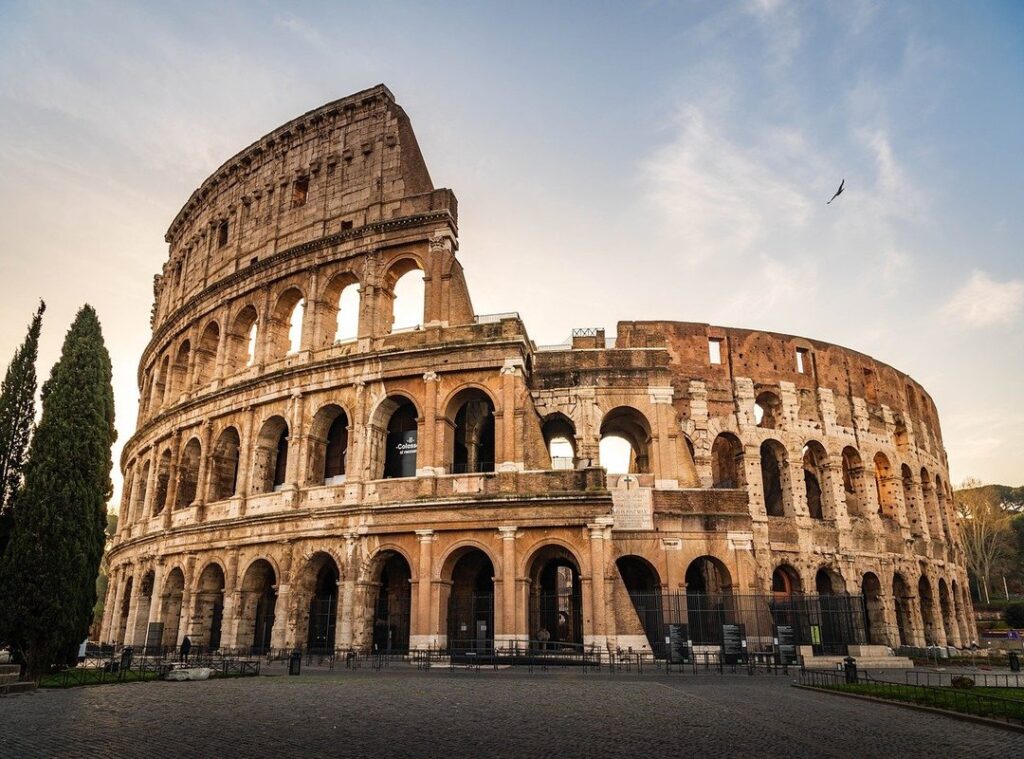
Engineering marvels sprang up everywhere. You’ve got the Colosseum, those impressive aqueducts, and the sprawling road networks. These weren’t just structures.
They were the veins of the empire, keeping everything connected.
But it wasn’t all smooth sailing. Some emperors were good, like Trajan and Marcus Aurelius, who brought stability and growth. Others?
Not so much. Caligula and Nero were more infamous. Absolute power tends to corrupt.
It added a layer of drama and chaos (as if Rome needed more).
Rome’s history feels alive when you look at these structures. It’s like seeing the past in 3D. The Colosseum still stands, a Rome’s architectural genius.
Roads stretched across continents. Aqueducts brought water to cities. These are things you can still see today, tangible connections to ancient Rome history.
And while you might not think Roman emperors have much to do with the Art Japanese Tea Ceremonies, both capture a sense of cultural grandeur that transcends time. Isn’t it fascinating how different cultures express their own forms of art and power?
The Great Decline: The Empire’s Tumultuous End
The “Crisis of the Third Century” was a mess. Picture ancient Rome spiraling into chaos. Civil wars erupting everywhere, the economy tanking, and barbarians barging in like they owned the place.

It was like the empire was trying to juggle flaming swords while riding a unicycle. The emperor needed a fix. Enter Diocletian.
He had this radical idea: split the empire into two parts, East and West, sort of like a massive corporation breaking into two divisions to handle its mess (probably seemed brilliant at the time).
Then came Constantine, with his game-changing moves. He shifted the capital to Constantinople and legalized Christianity. This wasn’t just a new paint job; it was a cultural overhaul.
Suddenly, the identity of the empire morphed into something different. But did it save the West? Not quite.
By 476 AD, the Western Roman Empire hit rock bottom. The fall wasn’t due to a single blow. It was a perfect storm (economic) issues, internal squabbling, and constant outside pressures.
Rome got sacked, and it was game over. This complex history paints a vivid picture of decline and can be explored further in the history of rome. Ancient Rome history is a saga of power, resilience, and eventual fragility.
It’s a reminder that even the mightiest can fall, often from within.
Rome’s Eternal Legacy: Still Standing Tall
When I think about ancient Rome, the first thing that hits me is its architecture. Those arches and domes. They’re everywhere.
Ever seen a government building or a fancy museum? Thank Rome. They invented concrete too, which is still a backbone of modern construction.
Then there’s language. Latin, the mother of Romance languages, is all around us. Spanish, French, Italian.
They all trace back to Latin roots. Even in science and law, Latin terms are key. It’s like ancient Rome history is written into our everyday words.
And don’t get me started on law and governance. “Innocent until proven guilty” is a Roman concept. Their Senate and republic ideas inspired the U.S. Founding Fathers.
It’s wild how these ancient ideas still shape our world.
So, while the empire may have crumbled, its influence never faded. Rome’s ideas and innovations are very much alive today.
A Journey Worth Taking
Diving into ancient Rome history is like opening a book filled with epic tales. From humble beginnings to a sprawling empire, Rome’s story seems endless. Feeling overwhelmed by it all?
You’re not alone. But breaking it down, we find a mix of human drama and achievement. This isn’t just dusty old history.
It’s our story too, shaping everything from our laws to our language. Curious yet? Feed that curiosity.
Explore more about Roman landmarks and culture. Travel deeper. Learn more.
You’ll see how much the past illuminates our present. Ready to start on this journey? Start now.
 Travel Content Manager
Thomas Harrisonevalons is the kind of writer who genuinely cannot publish something without checking it twice. Maybe three times. They came to destinations and cultural insights through years of hands-on work rather than theory, which means the things they writes about — Destinations and Cultural Insights, Drapizto Local Immersion Experiences, Drapizto Travel Essentials and Tips, among other areas — are things they has actually tested, questioned, and revised opinions on more than once.
That shows in the work. Thomas's pieces tend to go a level deeper than most. Not in a way that becomes unreadable, but in a way that makes you realize you'd been missing something important. They has a habit of finding the detail that everybody else glosses over and making it the center of the story — which sounds simple, but takes a rare combination of curiosity and patience to pull off consistently. The writing never feels rushed. It feels like someone who sat with the subject long enough to actually understand it.
Outside of specific topics, what Thomas cares about most is whether the reader walks away with something useful. Not impressed. Not entertained. Useful. That's a harder bar to clear than it sounds, and they clears it more often than not — which is why readers tend to remember Thomas's articles long after they've forgotten the headline.
Travel Content Manager
Thomas Harrisonevalons is the kind of writer who genuinely cannot publish something without checking it twice. Maybe three times. They came to destinations and cultural insights through years of hands-on work rather than theory, which means the things they writes about — Destinations and Cultural Insights, Drapizto Local Immersion Experiences, Drapizto Travel Essentials and Tips, among other areas — are things they has actually tested, questioned, and revised opinions on more than once.
That shows in the work. Thomas's pieces tend to go a level deeper than most. Not in a way that becomes unreadable, but in a way that makes you realize you'd been missing something important. They has a habit of finding the detail that everybody else glosses over and making it the center of the story — which sounds simple, but takes a rare combination of curiosity and patience to pull off consistently. The writing never feels rushed. It feels like someone who sat with the subject long enough to actually understand it.
Outside of specific topics, what Thomas cares about most is whether the reader walks away with something useful. Not impressed. Not entertained. Useful. That's a harder bar to clear than it sounds, and they clears it more often than not — which is why readers tend to remember Thomas's articles long after they've forgotten the headline.